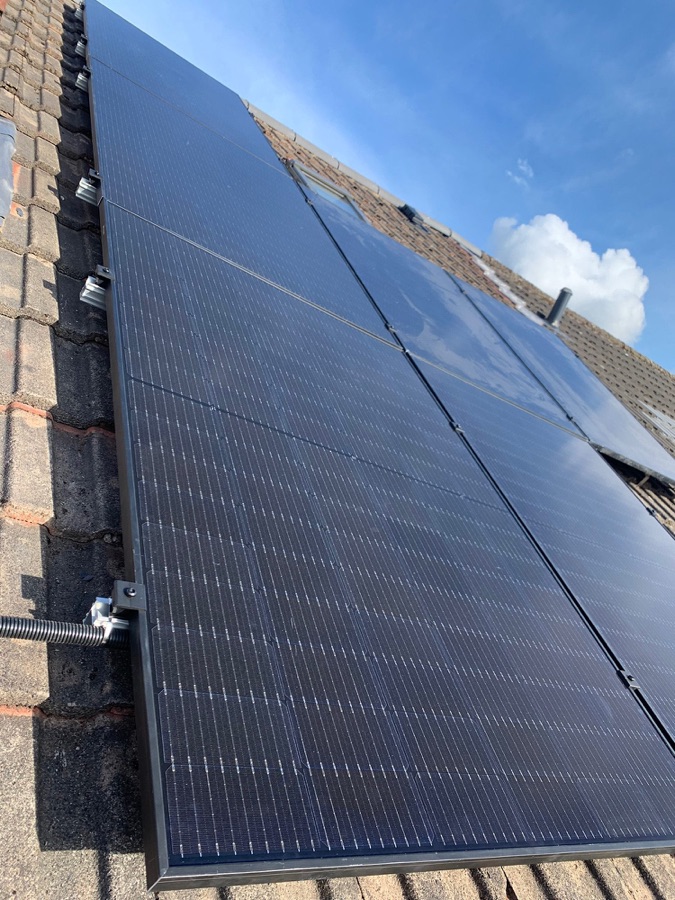
What "plug-in solar" actually is
A plug-in solar kit is one or more panels feeding a small microinverter that connects to your home's wiring through a standard wall socket, rather than a full rooftop system wired directly into your consumer unit by an MCS-certified installer. It's been common in Germany for years under the name "balcony solar" and is now being sold hard into the UK market: propped against a fence, bolted to a balcony rail, or leant against a shed wall.
The 800W cap, and how fast you actually hit it
UK plug-in solar is capped at 800 watts of AC output, measured at the microinverter rather than at the panels. That distinction matters more than most listings make clear. Most kits sold here pair two panels rated around 400–450W each with a single 800W microinverter. On a decent day, those two panels alone already reach or exceed that ceiling.
- Adding a third or fourth panel to "boost output" does very little once you're past that point. The inverter clips anything above 800W regardless of how much the panels could theoretically produce, and the extra capacity gets thrown away on a bright day. What it does help with is keeping output closer to 800W for longer through a cloudier day, not exceeding the cap.
- 800W is a ceiling, not a guarantee. In typical UK conditions (overcast, low winter sun, partial shade from a fence or a neighbouring building), expect meaningfully less than 800W most of the time, not the number on the box.
Why some of the marketing doesn't match reality
This space has a real problem with sponsored and cherry-picked reviews. Generation figures quoted in adverts and "independent" comparisons are often recorded on the sunniest possible day of the year, not a representative one, and sponsorship arrangements between manufacturers and reviewers are common and rarely disclosed clearly. A genuinely useful comparison shows generation logged across a normal week in typical weather, not a single clear afternoon dressed up as a yearly average.
Before you buy based on a claimed payback period, ask for real generation logs, not brochure projections. If a seller can't or won't show you data from an ordinary cloudy week, treat the headline savings figure with real scepticism.
The legal picture, honestly
At the time of writing, plug-in solar sits in a genuine grey area under UK wiring regulations: simply plugging a microinverter into an ordinary wall socket for a permanent installation isn't a connection method current guidance has sanctioned. That's changing: a statutory instrument (SI 2026/848) legalises plug-in solar in the UK from 27 August 2026, capping systems at 800VA / 800W AC output, single-phase, with a mandatory G98 notification to your electricity network operator within 28 days of installing.
Two things worth being clear-eyed about even once that's in force. First, G98 notification isn't optional: it's a legal requirement, not a suggestion, even though the form itself is a simple five-minute submission. Second, and more importantly: the new rules only cover panels and a microinverter plugged into a socket. Plug-in battery storage is explicitly excluded from the legalisation. Given the fire-safety questions around a battery sitting on ordinary socket wiring rather than a properly installed circuit, we wouldn't bet on that changing any time soon. If you want battery storage, it needs a proper installation regardless of what happens with plug-in panels.
Power cuts: plug-in solar gives you no independence at all
This is the part most buyers don't find out until the power actually goes off. Every grid-tied solar inverter in the UK, plug-in kits included, is required to shut down automatically during a power cut, a safety feature called anti-islanding that stops your panels from feeding electricity back into a network engineers might be working on (we cover the same behaviour for full systems in our FAQs). With a plug-in kit, that means the moment your street loses power, your panels stop delivering anything to your house, even in the middle of a bright, sunny day. There's no battery to fall back on, because plug-in batteries aren't legal, and even if that changes, a battery on its own doesn't fix this: without a hybrid inverter specifically built to support emergency backup, plus a transfer switch to isolate your circuits from the grid safely, a battery just sits there disconnected along with everything else. That's specialist hardware a simple 800W plug-in setup isn't designed around, and isn't likely to be any time soon. If "energy independence" is part of why you're considering solar, a plug-in kit, now or after August 2026, doesn't give you any.
What about a portable battery like an EcoFlow?
This is a genuinely common pairing, and worth separating from the "plug-in battery storage" the new regulations exclude. A portable power station (EcoFlow and similar brands are the best-known examples) usually charges straight from the panels' DC output rather than plugging into the microinverter at all, and it powers its own sockets independently of your home's wiring. That's not touched by SI 2026/848 one way or the other; it simply sits outside the grid-connected system the regulations are about.
The catch is in how these units get marketed. A model advertised as storing "2kWh" or "3kWh" sounds like a lot of headroom, but stored capacity and continuous output are two different specifications, and it's easy to conflate them. Plenty of popular portable power stations cap their AC output at around 800W, coincidentally the same number as the legal plug-in solar limit, though here it's the unit's own built-in inverter doing the capping, nothing to do with the law. However much energy is sitting in the battery, you can only draw up to that ceiling at any one moment. A kettle, hairdryer, microwave or immersion heater typically pulls 2–3kW (several times what the unit can put out), so it simply won't run, no matter how full the battery reads. What you do get is genuinely useful backup for low-draw essentials: a router, a laptop, some lighting, phone charging. That's a real, useful bit of kit, just not a substitute for a proper home battery system once you're talking about anything that actually pulls serious power.
A proper system, with or without battery
Compare that to an MCS-certified system wired into your consumer unit by a qualified installer, and the picture changes completely:
- Without a battery, a typical residential system runs 3–6kWp, several times the plug-in ceiling, and you get paid for what you export through the Smart Export Guarantee. See our solar calculator for what that looks like on your own roof. A plug-in kit gets you neither the extra capacity nor the export income.
- With a battery, sized alongside a hybrid inverter that specifically supports emergency backup, you get something a plug-in setup can't offer at any price: circuits that keep running during a power cut (lights, the fridge, the WiFi router) while the grid's down. We go into the full with-versus-without comparison in our battery storage article.
The bigger upfront cost of a proper installation isn't just "more panels for more money." It's what actually buys the higher power ceiling, the export payments, the option of genuine backup power, and the MCS certification that makes all of that possible in the first place. None of that is something a plug-in kit can be upgraded into later. It's a different category of product, capped by design from day one.